
In short: A symphony orchestra is a large classical ensemble of about 70 to 100 musicians, arranged in four sections: strings, woodwind, brass and percussion, led by a conductor. It took its modern shape between Haydn’s time in the late 18th century and the large orchestras of Mahler and Strauss around 1900. Updated 20 November 2026.
What the words mean
The word “symphony” comes from the Greek symphonia, meaning “sounding together” or agreement of sound. Over centuries it was used for many kinds of music before it settled, in the 18th century, on its modern meaning: a large musical composition for orchestra, usually in four movements, with the first movement often in sonata form. A symphony orchestra is simply an orchestra big enough to play such works. The terms “symphony orchestra” and “philharmonic orchestra” mean the same thing; the name usually reflects a city’s history rather than any musical difference.
How the orchestra grew
The classical orchestra
In Haydn’s and Mozart’s day, in the second half of the 18th century, an orchestra had a string section plus pairs of flutes, oboes, bassoons, horns and trumpets, with timpani. Clarinets arrived towards the end of the century. Haydn alone wrote over a hundred symphonies for orchestras of this size, often only 30 to 40 players.
Beethoven and the early Romantics
At the start of the 19th century, Beethoven turned the symphony from an everyday genre into the most ambitious form in music. His Fifth, Sixth and Ninth symphonies brought trombones, until then used mainly in church and theatre music, into the symphony, and the Ninth added a choir and soloists. Felix Mendelssohn wrote five symphonies, plus thirteen early string symphonies, and Robert Schumann wrote four, both working in a broadly classical mould with their own musical language.
Berlioz and programme music
Hector Berlioz favoured works that tell stories. His Symphonie fantastique (1830) follows an artist’s opium dream; Harold en Italie features a solo viola; and Roméo et Juliette is a “dramatic symphony” with voices. His Grande symphonie funèbre et triomphale of 1840 was written for a military band of about 200 players performing outdoors, one of the first symphonies for band. Berlioz also wrote a famous treatise on orchestration that shaped how later composers used the orchestra.
The late 19th century
Through the 19th century, the orchestra kept growing. Percussion instruments once used only for “Turkish” colour, such as the bass drum, cymbals and triangle, became regular members. More wind parts demanded more string players to balance them. By the time of Brahms, Tchaikovsky and Dvořák, the orchestra looked much as it does today.
Mahler, Strauss and beyond
Around 1900, Gustav Mahler and Richard Strauss wrote for huge forces: quadruple woodwind, eight or more horns, extra brass and large percussion sections. Mahler’s Eighth Symphony is nicknamed the “Symphony of a Thousand”. In the 20th century, composers such as Stravinsky, Prokofiev and Shostakovich kept the large orchestra but used it in new ways, and film composers made it the sound of cinema.
The four sections
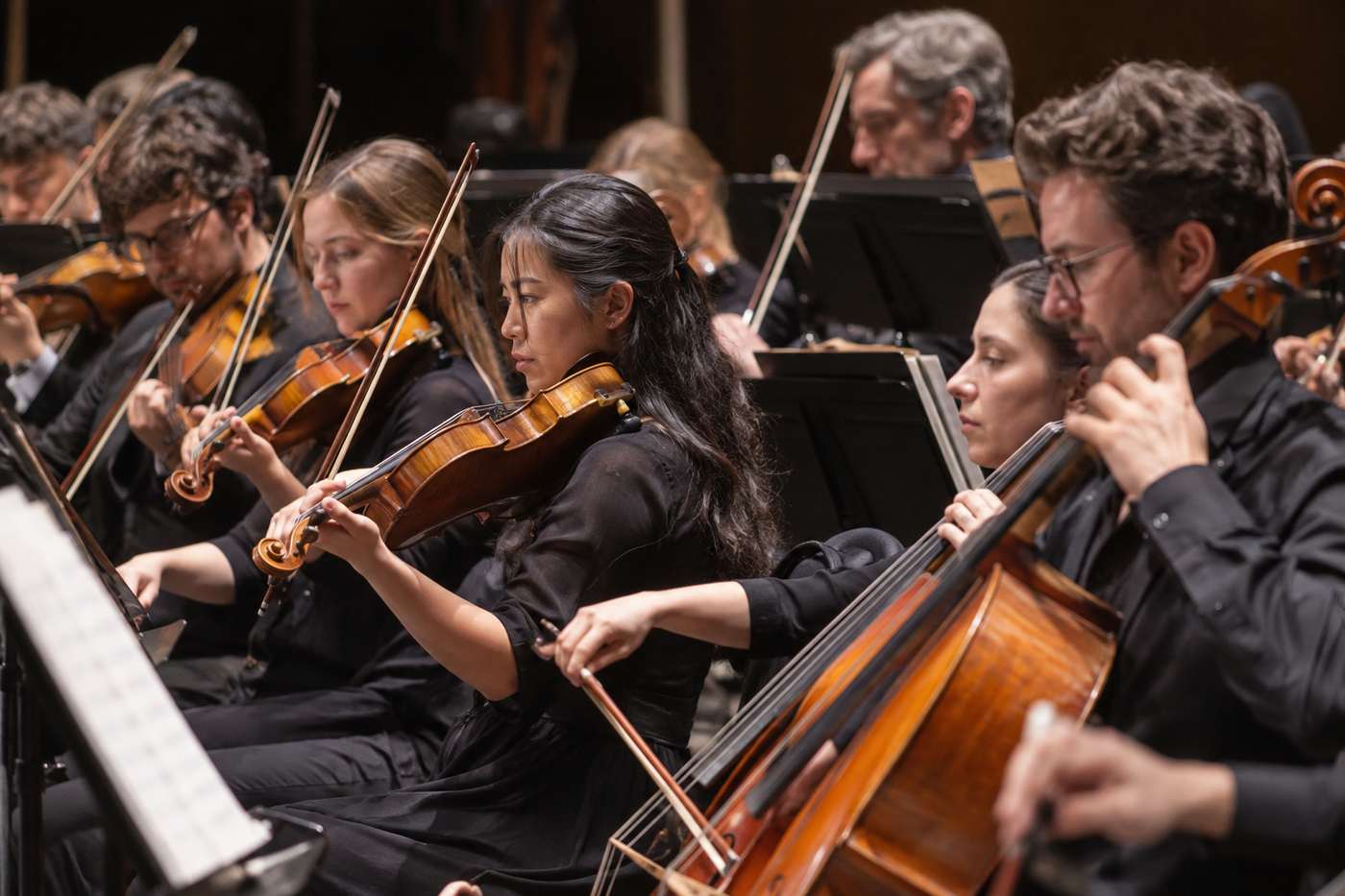
- Strings: first and second violins, violas, cellos and double basses. The largest section, often 50 to 60 players, and usually sitting at the front. The harp is often grouped with them.
- Woodwind: flutes and piccolo, oboes and cor anglais, clarinets and bass clarinet, bassoons and contrabassoon.
- Brass: horns, trumpets, trombones and tuba.
- Percussion: timpani plus bass drum, snare drum, cymbals, triangle, xylophone, glockenspiel and many more.
Our guide to the instruments of a modern symphony orchestra looks at each one.
Who does what
The conductor chooses tempos, balances the sections and shapes the interpretation, and in most orchestras the music director also plans the season. The concertmaster, or leader, is the principal first violinist: they tune the orchestra, play the violin solos and lead the strings. Each section has a principal player who leads it and plays its solos. Behind the stage, librarians, stage managers and administrators keep everything running.
How big is a symphony orchestra?
Most modern symphony orchestras have between 70 and 100 players, depending on the music. A Mozart symphony may need only 35 to 40; a Mahler symphony can need well over 100. Chamber orchestras, with around 15 to 40 players, play the earlier repertoire and smaller modern works.
Common questions
What is the difference between a symphony and a philharmonic orchestra?
None in musical terms. Both are full-size orchestras; the name usually comes from the orchestra’s history or to tell two orchestras in the same city apart.
How many movements does a symphony have?
Usually four, but many symphonies have three, five or even one movement.
Why does the oboe tune the orchestra?
Its clear, penetrating sound is easy to hear across the stage, and its pitch is hard to adjust quickly, so the other players tune to it.